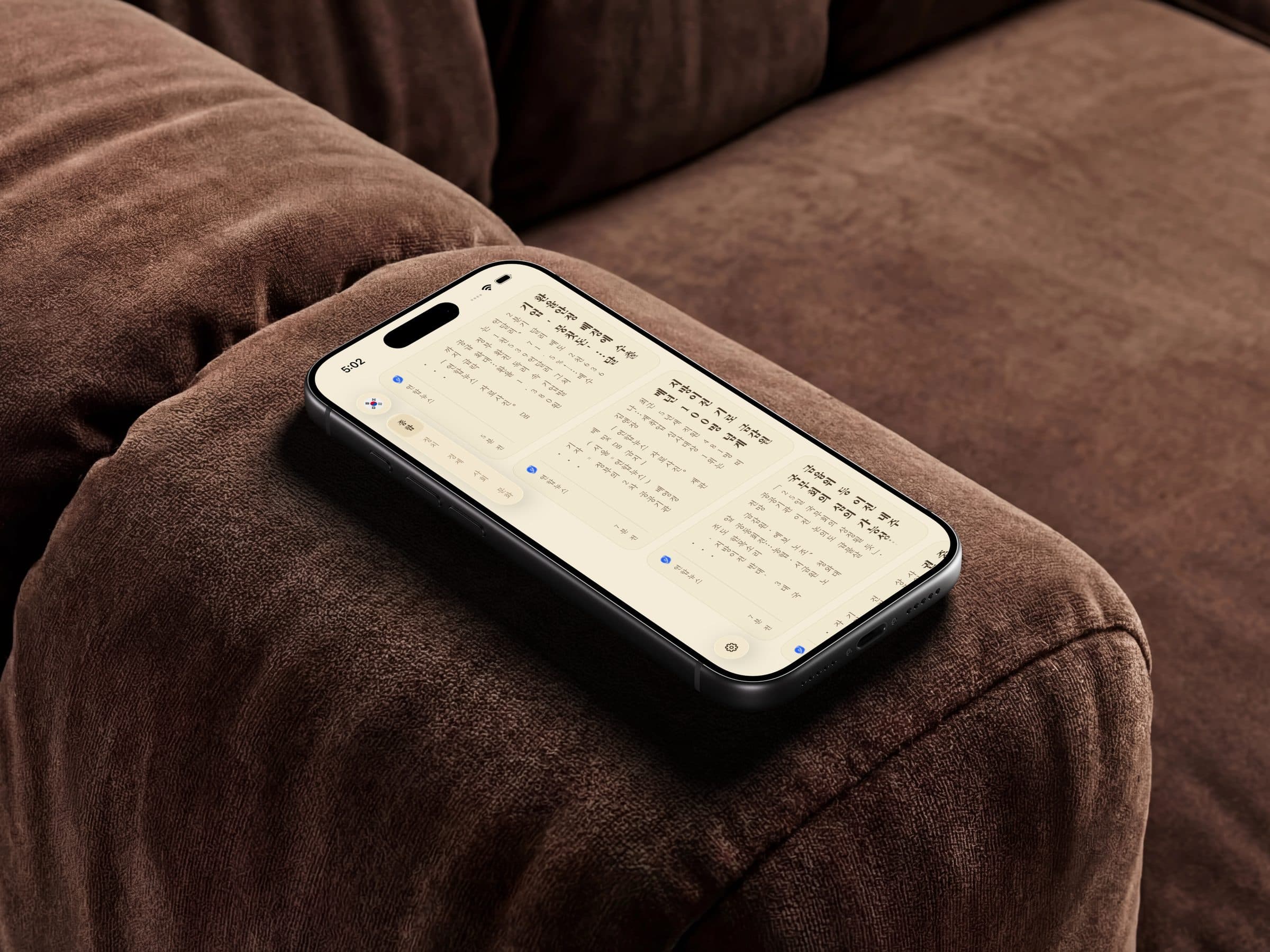
Up close
Pull to turn the page
Articles paginate as tiered columns. Overscroll past the leftmost column and a ring fills with the pull; release early and the page settles back. At 100% the next page enters from the left edge, tracking the pointer 1:1 and interruptible the whole way.
The front page and the article
The front page stacks headlines as full-height cards, the lead story at the right edge and forward running leftward. Open one and it becomes a two-tier page: a headline tier above the hairline, body columns below, turning a row at a time instead of scrolling without end.
Three editions, three newspapers
한 · あ · 中 are not three translations of one feed. Each edition carries its own sources — 연합뉴스·한겨레·KBS, NHK·朝日, BBC 中文·中央社 — and its own chrome language, and the typography re-sets for the script. Switching editions switches newspapers.
The typography stress test
Live headlines arrive unsanitized — digit runs, Latin acronyms, corner brackets — several times an hour, and every line runs the same pipeline: 縦中横 sets 3.50% upright, CPTPP stands as one cluster, ﹁ ﹂ take their vertical forms, kinsoku decides the breaks. Curated samples would flatter the system; the wire does not.
The left arrow means next
Pages answer the keyboard the way the page runs: ← enters the next page from the left edge, → steps back. The motion is the meaning — the same leftward entry the pull gesture earns by hand, earned here by a key.
Features
The front page, restored
Live RSS headlines as full-height vertical columns. The first story sits at the right edge, forward is leftward: the front page digital news would have kept if it had inherited 세로쓰기/縦書き.
Three editions
한 · あ · 中 each carry their own sources (연합뉴스·한겨레·KBS, NHK·朝日, BBC 中文·中央社), chrome in that edition's language. Switching editions switches newspapers, not translations.
The typography stress test
Real headlines are full of dates, tickers, and acronyms. Every feed line runs through the typography pipeline: verticalized punctuation, tate-chu-yoko (縦中横) digit runs, kinsoku/금칙 line breaking.
Pull to turn the page
Articles paginate as tiered columns. Overscroll past the leftmost column and a ring fills with the pull; at 100% the next page enters from the left edge, interruptible and tracking the pointer 1:1.
Sources you own
Toggle default feeds per edition and add any RSS URL beside them. The Sources sheet shows a dead feed's failure and never blanks the front page.
Design Decisions
Why a newspaper?
Newspapers are the strongest historical case for vertical CJK setting. For over a century, Korean, Japanese, and Chinese dailies ran top to bottom, right to left, and Japanese national papers still do in print. Every digital edition fell back to horizontal. Restoring it here, where digital dropped it, matters most.
Why live feeds instead of curated demos?
Hand-picked samples flatter a typography system; live headlines don't. They arrive full of digits, Latin acronyms, and mixed punctuation, several times an hour. Hold up against a real news day and you hold up anywhere.
Why does the left arrow mean next?
On a right-to-left axis, forward is leftward. The keyboard follows the reading, not screen convention: ← turns to the next page, → goes back, pages enter and exit at the left edge. Reversing it to match horizontal habits would break the premise being tested.